Key Takeaways
Getting a tattoo in Mauritius is safe at a professionally run studio that uses single-use sterile needles, autoclave-sterilises all reusable equipment, and works from licensed commercial premises. The real risks — blood-borne infection, bacterial skin infection, and allergic reaction — come almost entirely from hygiene shortcuts, not from tattooing itself. That's why a suspiciously cheap price is a safety red flag rather than a bargain. Before booking, confirm you'll see sealed needles opened in front of you, fresh gloves, disposable barrier film on every surface, and single-use ink caps. Mauritius' tropical heat and humidity raise infection risk while a tattoo heals, so aftercare matters more here than in cooler climates. Always visit or consult first and ask to see the studio's hygiene setup before you commit.
On this page
Key Takeaways
Getting a tattoo in Mauritius is safe at a professionally run studio that uses single-use sterile needles, autoclave-sterilises all reusable equipment, and works from licensed commercial premises. The real risks — blood-borne infection, bacterial skin infection, and allergic reaction — come almost entirely from hygiene shortcuts, not from tattooing itself. That's why a suspiciously cheap price is a safety red flag rather than a bargain. Before booking, confirm you'll see sealed needles opened in front of you, fresh gloves, disposable barrier film on every surface, and single-use ink caps. Mauritius' tropical heat and humidity raise infection risk while a tattoo heals, so aftercare matters more here than in cooler climates. Always visit or consult first and ask to see the studio's hygiene setup before you commit.
A tattoo is a small, controlled wound, and like any wound it can go wrong if it's handled badly. The good news is that almost everything that goes wrong is preventable, and it comes down to one thing: the studio's hygiene. This guide is the deep dive on that one thing — what "safe" actually means, what to look for, and how to tell a properly run studio from a risky one. For the wider picture — styles, prices, choosing an artist — see our complete 2026 guide to tattoos in Mauritius.
What can go wrong — and why it rarely does
Let's be honest about the risks rather than pretend they don't exist. There are four worth understanding:
Blood-borne infection. Hepatitis B, hepatitis C and HIV can in principle be transmitted through contaminated needles. This is the risk people fear most, and it is also the one that proper practice eliminates almost entirely — single-use sterile needles, opened from sealed packaging and discarded after one client, leave no route for transmission.
Bacterial skin infection. The more common, everyday risk. It comes from contaminated equipment, an unclean environment, or poor aftercare, and it's why barrier film, fresh gloves and clean surfaces matter as much as the needle itself. In a warm climate it's also why aftercare can't be casual.
Allergic reaction. Usually to ink pigments, occasionally to aftercare products. Reactions are uncommon and rarely serious, but a good artist will ask about your skin and any history of allergies before starting.
Poor healing and scarring. Not strictly a hygiene issue, but linked — an infected tattoo heals badly, and a tattoo applied with poor technique or aftercare can scar or blow out.
The pattern across all four is the same: the danger isn't tattooing, it's a tattoo done without proper hygiene. Get the studio right and the risk drops to something genuinely small.
The hygiene checklist: what a safe studio looks like
This is the core of the whole subject. In any legitimate studio in Mauritius — or anywhere — you should be able to see the following, and you're entitled to ask about all of it:
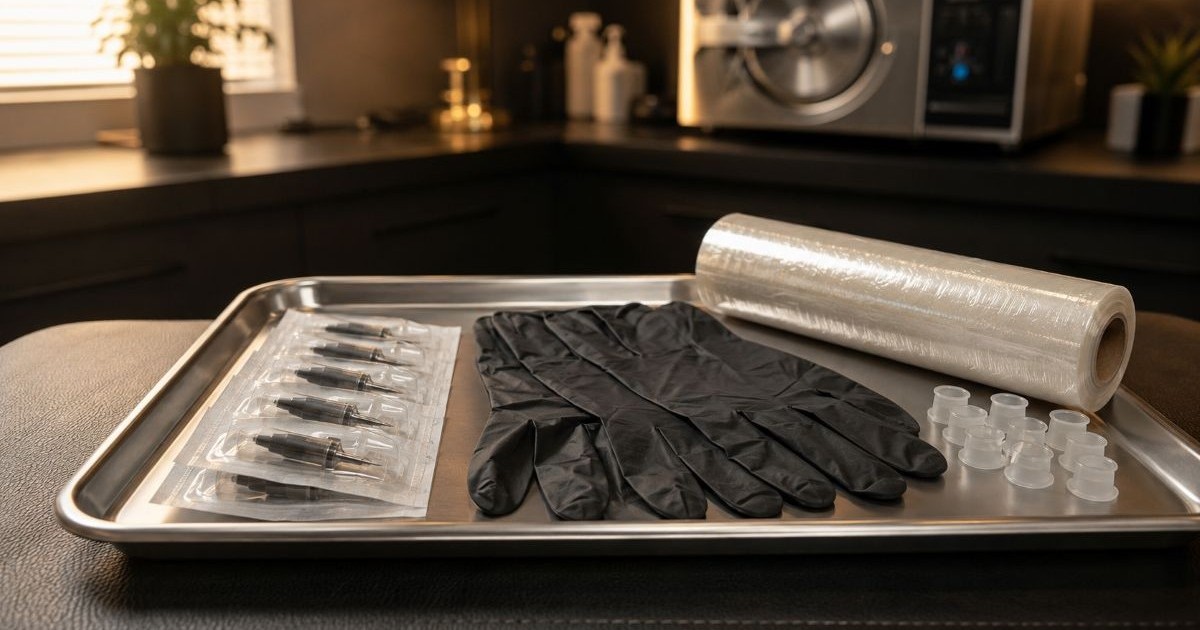
- Single-use sterile needles, opened in front of you from sealed, dated packaging and disposed of after your session.
- An autoclave on site for sterilising any reusable metal equipment (more on this below).
- Fresh latex or nitrile gloves for every client, changed during the session if the artist touches anything non-sterile.
- Disposable barrier film wrapping the tattoo machine, the clip cord, the work surfaces and the bottle caps — anything the artist's hands or the equipment will contact.
- Single-use ink caps, with ink poured fresh for you and never tipped back into a shared bottle.
- A sharps bin — a certified container for safe disposal of needles.
- Visible hand hygiene and a clean-down routine between clients.
- A clean, bright, organised space. Mess and clutter are not a style choice; they're a hygiene tell.
A studio that does this properly isn't doing anything heroic — it's doing the basic, boring, essential work that makes a tattoo safe. And one that's confident in its setup will show you without being asked.
Single-use needles and autoclave sterilisation
Two ideas do most of the heavy lifting in tattoo safety, and they're worth understanding clearly.
Single-use needles are exactly what they sound like: a sterile needle and tube assembly used for one client and then thrown away. Because the needle is the one item that breaks the skin, making it single-use removes the main route by which infection could pass from one person to another. There is no cleaning or reusing — it comes sealed and sterile, and it leaves in the sharps bin.
Autoclave sterilisation handles the items that aren't disposable, such as certain reusable grips. An autoclave uses pressurised steam at high temperature to destroy all microorganisms, including bacterial spores that ordinary disinfectant won't touch. This is the distinction that catches people out: wiping equipment with alcohol or a surface spray is disinfection, not sterilisation. Only an autoclave (or an equivalent validated process) truly sterilises. Reputable studios also test their autoclave regularly to confirm it's actually reaching the conditions needed.
If a studio can't tell you how it sterilises reusable equipment, or relies on a spray bottle, that's not a small gap. It's the gap.
Warning signs: when to walk away
If you see any of these, leave — politely, but leave:
- Reused needles, or needles that aren't opened in front of you.
- No autoclave anywhere in sight, and no clear answer about how reusable equipment is sterilised.
- An artist not wearing gloves, or wearing the same pair between clients.
- Ink poured back into a shared bottle after use.
- No health-history questions before starting.
- No fixed studio address — work done from a home, a hotel room, a beach stall or a market table.
- A price far below the market (we'll come to why that matters next).
None of these is a matter of taste or atmosphere. Each one is a direct route to an infection or a botched tattoo, and a professional studio won't tolerate any of them.
Why a suspiciously cheap tattoo is a safety issue
It's tempting to treat a low quote as a win, especially on holiday. It usually isn't. Sterile single-use needles, autoclave maintenance, quality ink, licensed premises and trained hands all cost real money, and they don't get cheaper. So when a price sits far below the going rate, the saving has to come from somewhere — and it's almost always one of the things you can't see: the sterilisation, the disposables, the training, the premises.
We cover the numbers in our 2026 Mauritius tattoo price guide, but the safety version is short: a tattoo that costs a fraction of the market rate is not a bargain, it's a corner cut. And the cost of a bad outcome — treating an infection, or removing and reworking a poor tattoo — comfortably outweighs anything you saved on the day.
Infection risk in Mauritius' tropical climate
Here's the part generic safety advice misses: in Mauritius, the studio is only half the story. The other half is the climate your tattoo heals in.
Warm temperatures and high humidity create conditions bacteria like. Sea water and swimming pools — the whole reason many people are here — carry organisms that can infect an open, healing tattoo. Strong sun damages healing ink and irritated skin. Heavy sweat softens scabs and invites infection. None of this makes Mauritius a bad place to get tattooed; the studios are as clean as anywhere. It simply means the healing window demands real discipline.
For the first two to three weeks: no direct sun on the tattoo, no sea or pool, short lukewarm showers only, no sweaty workouts, and gentle washing with the aftercare routine your artist gives you. We go into the full tropical-climate aftercare routine in a dedicated guide, but the safety point stands on its own — half of "is it safe" is what you do after you leave the chair.
Once your tattoo is done, caring for it properly in this climate matters as much as the studio's hygiene. See our guide to tattoo aftercare in Mauritius' tropical climate.
How to check a studio is safe before you book
You don't need to take any of this on trust. Before you commit, do four simple things:
- Visit or consult first. A free consultation, in person or by message, lets you see the space and meet the artist before any money changes hands. Reputable studios in Mauritius expect this.
- Ask the direct questions. Are needles single-use? How is reusable equipment sterilised? A confident studio answers easily; a defensive or vague answer is itself an answer.
- Look at healed work, not just fresh shots. Ask to see photos of tattoos in your style after they've healed. Healed work tells you about technique and, indirectly, about aftercare guidance.
- Check reviews across platforms. Google, TripAdvisor and social all together give a fuller picture than any one of them. Look for detailed written reviews, not just star counts.
Any studio worth your skin will welcome every one of these. The ones that bristle are telling you something.
Licensing and legal standards in Mauritius
Mauritius does not yet have a single dedicated regulator for the tattoo industry, which means the responsibility for standards sits largely with the studios themselves — and that's exactly why choosing carefully matters. Professionally run studios register as businesses under the Mauritius Revenue Authority and follow public-health guidance on body-art hygiene. Reputable studios also decline to tattoo anyone under 18, and ask for ID.
The practical markers of a legitimate operation are straightforward: a fixed commercial address, visible hygiene practices, an honest consultation, and no resistance to the questions above. Glamour Tattoo Studio operates from a fixed commercial address on La Salette Road in Grand Baie, uses single-use needles and hospital-grade sterilisation across every appointment, and starts every new client with a free, unhurried consultation — including any questions you have about how we keep the work safe.
FAQ
Is it safe to get a tattoo in Mauritius?
Yes, at a professionally run studio that uses single-use sterile needles, autoclave-sterilises reusable equipment, changes gloves for every client, and works from a fixed address. The risk depends far more on the studio you choose than on being in Mauritius.
How can I tell if a tattoo studio is hygienic?
Look for sealed needles opened in front of you, an autoclave on site, fresh gloves, disposable barrier film, single-use ink caps, and a sharps bin — in a clean, organised space. A confident studio will show you its setup before you book.
Can you get an infection from a tattoo in Mauritius?
It's possible with any tattoo anywhere, but rare when the studio follows proper hygiene and you follow aftercare. Mauritius' heat, humidity, sea and pools raise the risk during the healing window, so aftercare here needs more discipline.
What does properly sterilised equipment look like?
Single-use sterile needles opened in front of you and discarded after. Reusable metal items cleaned and then sterilised in an autoclave using pressurised steam. Wiping with alcohol or disinfectant is not sterilisation.
Is it safe to get a tattoo on holiday in a tropical climate?
Yes, with planning. Choose a clean studio, then keep the fresh tattoo away from sun, sea, pools and heavy sweat for two to three weeks. Time it early in the trip with shaded days after, or late with protection for the journey home.
Are tattoo studios in Mauritius licensed or regulated?
There's no single dedicated tattoo regulator yet. Legitimate studios register as businesses under the Mauritius Revenue Authority, follow public-health hygiene guidance, and won't tattoo minors. A fixed address and openness about hygiene are the practical signs of a real operation.
Are cheap tattoos in Mauritius dangerous?
A price far below the market range is a warning sign. Sterile equipment, sterilisation, quality ink and trained artists all cost money, so a very low price usually means a corner has been cut — often one you can't see.
What should I ask before booking?
Whether needles are single-use, how reusable equipment is sterilised, to see healed work in your style, and to view reviews across platforms. Confirm the studio has a fixed address rather than working from home or a hotel room.
Does Glamour Tattoo Studio use single-use needles?
Yes — single-use sterile needles for every client and hospital-grade sterilisation for all reusable equipment, from a fixed address on La Salette Road, Grand Baie. Every new client starts with a free consultation where you're welcome to ask about hygiene first.
Want to see how we keep it safe before you book? Get in touch with Glamour Tattoo Studio for a free, no-pressure consultation — come and see the studio, meet the team, and ask anything you like about hygiene before you commit to a thing.
This guide was written by Vicky Mannick, master tattoo artist and founder of Glamour Tattoo Studio in Grand Baie, Mauritius, drawing on over 20 years of professional tattooing experience. Last reviewed June 2026.
By Vicky Mannick
Master Tattoo Artist & Studio Owner
Master tattoo artist with over 20 years of experience, specialising in Polynesian, Maori, realism and custom tattoo work. Founder of Glamour Tattoo Studio in Grand Baie, Mauritius.
Ready to book your consultation?
Talk through your idea with Vicky and the team — free consultation, firm quote before any work begins.
Book a consultationMore from the guide
More guides coming soon.