Key Takeaways
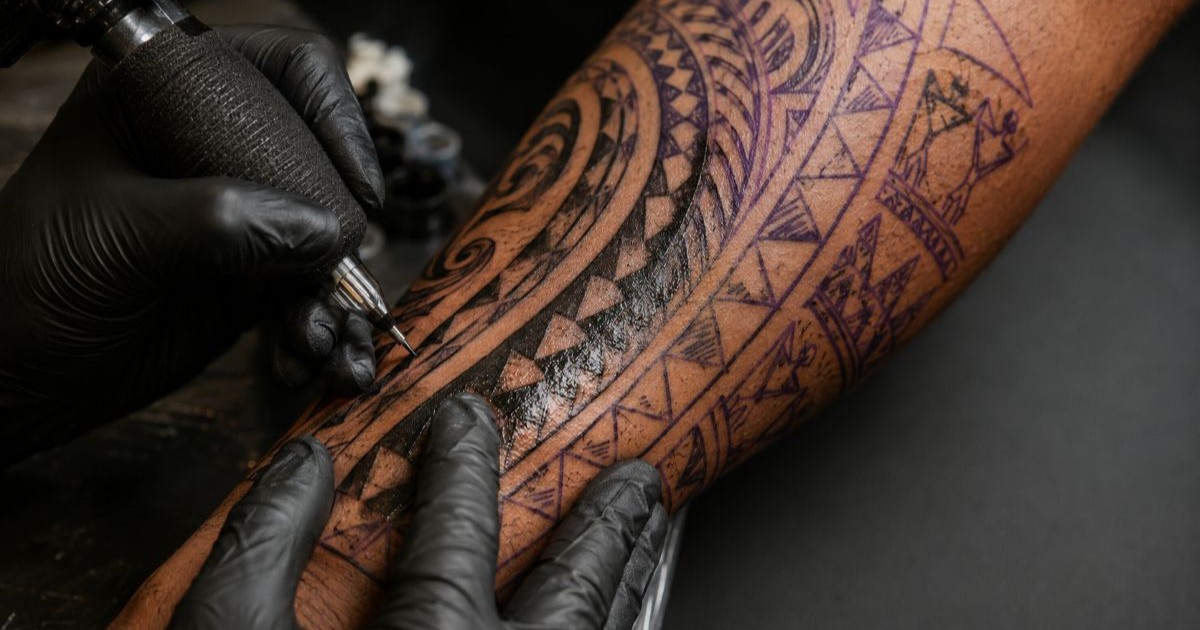
Polynesian and Maori-style tattoos are among the most requested styles in Mauritius. The two traditions are related but distinct: Polynesian (tatau) refers to a family of styles from Samoa, Tonga, Tahiti, the Marquesas, Hawaii and elsewhere across the Pacific, while tā moko refers specifically to Maori tattooing from Aotearoa (New Zealand). Both use bold black geometric line work with deep symbolic meaning — waves for life journey, turtles for family and longevity, enata figures for ancestors and people. For non-Polynesian and non-Maori clients, the ethical approach is custom Polynesian-inspired work that draws on the visual language without copying sacred motifs or facial tā moko, which traditionally belongs to Maori people. Expect MUR 6,000–15,000 for a medium piece and MUR 25,000+ for a sleeve, typically across multiple sessions. Book a free consultation to discuss your idea before committing to a design.
On this page
Key Takeaways
Polynesian and Maori-style tattoos are among the most requested styles in Mauritius. The two traditions are related but distinct: Polynesian (tatau) refers to a family of styles from Samoa, Tonga, Tahiti, the Marquesas, Hawaii and elsewhere across the Pacific, while tā moko refers specifically to Maori tattooing from Aotearoa (New Zealand). Both use bold black geometric line work with deep symbolic meaning — waves for life journey, turtles for family and longevity, enata figures for ancestors and people. For non-Polynesian and non-Maori clients, the ethical approach is custom Polynesian-inspired work that draws on the visual language without copying sacred motifs or facial tā moko, which traditionally belongs to Maori people. Expect MUR 6,000–15,000 for a medium piece and MUR 25,000+ for a sleeve, typically across multiple sessions. Book a free consultation to discuss your idea before committing to a design.
Polynesian and Maori-style tattoos have become some of the most requested styles at Glamour Tattoo Studio over the past two decades — and across the wider Mauritian tattoo scene. They're powerful, deeply visual, and built around the kind of personal symbolism that ages well as the people wearing them age. They're also surrounded by more confusion and bad information than almost any other tattoo style, especially online. This guide is the version of the conversation I have with clients during their first consultation — what these traditions are, what the visual language means, how to wear them respectfully if you're not from those cultures, and what to expect when you book one with us.
For wider context on getting tattooed in Mauritius — studios, hygiene, aftercare — see our complete 2026 guide to tattoos in Mauritius.
Why Polynesian and Maori tattoos resonate in Mauritius
Mauritius isn't Polynesian. We're an Indian Ocean island with African, Indian, Creole, Chinese and European heritage — not Pacific. So why do Polynesian and Maori-style tattoos travel so well here?
The honest answer is a mix of reasons. The visual language — bold black geometric work, water and ocean motifs, the integration of personal story into the design — connects naturally with island life and a sea-facing culture. The styles also age beautifully. Solid black work holds up over decades in a way that colour and fine detail simply don't, which matters when you live under tropical sun.
There's also a practical reason: many of our clients are international visitors from France, Réunion, South Africa, Australia and the UK, where Polynesian and Maori-influenced tattooing has been mainstream for years. They arrive in Mauritius already thinking about this style and look for a studio that takes it seriously rather than offering a watered-down version.
The result is that a small group of Mauritian artists — and Glamour is one of them — have spent years developing genuine craft in these styles. Not because we're Polynesian or Maori, but because the demand has been steady and the work rewards careful attention.
Tatau vs tā moko: what's actually different
The single most common mistake clients make at consultation is treating "Polynesian" and "Maori" as interchangeable. They're not. Understanding the difference helps you make a better decision about what you actually want.
Polynesian (tatau) is an umbrella term covering several related but distinct traditions across the Pacific. Samoan tatau, Tahitian, Marquesan, Hawaiian, Tongan and others all share a visual vocabulary — geometric blocks, repeating linear patterns, motif libraries built around the natural world — but each has its own conventions, motifs that mean specific things in that culture, and historical associations. The word "tatau" itself, from Samoan, is the origin of the English word "tattoo."
Tā moko is specifically Maori tattooing, from Aotearoa (New Zealand). It developed in relative isolation from broader Polynesian traditions and has a visibly distinct style — heavy use of curvilinear spirals (koru), a unique approach to composition, and the tradition of facial tā moko, which is one of the most recognisable elements of Maori visual culture. Tā moko is closely tied to whakapapa, the genealogical lineage system, and to specific cultural protocols that don't apply to Polynesian work the same way.
In practical terms, when people in Mauritius say "Polynesian tattoo," they usually mean a Marquesan-influenced or generalised Pacific style — bold geometric line work, waves, turtle elements, enata figures. When they say "Maori tattoo," they usually mean designs that include koru spirals and the heavier curving forms.
A good artist will ask which one you actually want and steer the design accordingly. If your reference images are a mix of both, expect to be asked which direction you want to lean.
Common motifs and what they generally mean
Polynesian and Maori designs are built from a library of recurring motifs, each carrying common interpretations. These aren't fixed meanings — they vary by tradition, by region, and by the artist composing the piece — but the categories below give you a working vocabulary for designing your own.
Water and waves — Life journey, change, the unknown ahead. Often used as background fill or as a connecting element between other motifs.
Turtle (honu) — Family, longevity, health, navigation. One of the most universally used Polynesian motifs and one of the most flexible — turtles can hold entire compositions in their shell pattern.
Enata — Small human figures, often stylised as triangles with limbs. Represent people in your life — ancestors, family members, friends. The number, arrangement and direction of enata figures can encode personal genealogy.
Sun — Eternity, leadership, brilliance, the journey from darkness to light. Often used as a centrepiece on the chest or shoulder.
Spear heads and shark teeth — Strength, protection, courage. Often used as borders or framing elements.
Lizards and geckos — Communication between worlds, supernatural connection. More common in Tahitian and Hawaiian work.
Tiki — A stylised human figure, often associated with protection from spirits or ancestral guardians. Use with care — some forms are considered sacred and require cultural connection.
Koru — Specifically Maori. The unfurling fern spiral. Represents new life, growth, peace.
Mango (shark) — Strength, ferocity, protection, the guardian of family. Used widely across Polynesian traditions.
A common request at consultation is: "I want a turtle, some waves, and a sun." That gives us enough to start, but the real conversation is about what those elements mean to you — your family, your story, the milestones the piece is meant to mark. That's how a design becomes yours rather than a generic Polynesian sleeve.
Is it OK to get one if you're not Polynesian or Maori?
This is the question I get asked most often, usually quietly, at the end of the consultation. The short version: yes, with care — but the care matters.
Most Polynesian artists and cultural commentators distinguish between respectful and disrespectful approaches rather than imposing blanket bans on non-Polynesian people wearing the style. The respectful path looks like this:
- Custom work, not copied designs. A design developed around your own story, family and meaningful symbols is both more personal and more respectful than lifting an existing tattoo from the internet — which is often someone else's sacred lineage or a culturally specific piece you have no connection to.
- Working with an artist who'll push back. If you ask for a motif that's culturally specific or sacred, a good artist will tell you and suggest an alternative. Someone who says yes to anything isn't doing you a favour.
- Honest framing. Wearing the tattoo because the visual language and meaning resonate with you is a different thing from claiming a spiritual lineage you don't have. The first is fine; the second causes offense.
Tā moko, especially facial tā moko, is a different conversation. Maori cultural authorities have explicitly asked non-Maori people not to wear tā moko, and the request has been consistent enough across decades that reputable artists outside the Maori community decline these requests as a matter of principle. Maori-inspired designs that use elements of the visual language (koru spirals, for example) without copying sacred or facial work fall into a different category and are usually fine. Your artist can talk you through where the line falls for your specific design.
This is the kind of conversation that's hard to have through a contact form. Bring it up at your consultation. We'll be honest with you about what we'll do and what we won't.
Designing a piece that's respectful and personal
The strongest Polynesian and Maori-style work doesn't come from copying a reference image. It comes from a conversation. Here's how the design process runs at our studio:
1. The first consultation (free, 30–45 minutes). We sit down and talk through what you actually want this tattoo to mark — a family, a milestone, a place, a chapter of your life that's closing or opening. The reference images you bring are useful but they're a starting point, not the destination. Bring whatever you've collected, and also bring the story.
2. Motif selection. Based on that conversation, we suggest motifs that connect to what you've described. If your story is about family and your three kids, that's enata figures. If it's about navigating a difficult period, that's waves and water. If it's about your grandmother who raised you, that's specific symbols we'll work out together.
3. Composition sketch. I draft a rough composition — placement, scale, flow across the body. For a sleeve, this includes how the design wraps and what the negative space does. We review the sketch together and adjust.
4. Refined design. Once the composition works, I refine it into a final design ready for stencil. This sometimes takes a few days for larger pieces. You approve the design before any session is booked.
5. The sessions. Larger pieces are split across two to six sessions, scheduled over weeks or months. Each session typically runs three to five hours.
This isn't a fast process — and it shouldn't be. The work you're putting on your body is supposed to last forever. The few weeks between consultation and first session are part of getting it right.
Pricing for Polynesian and Maori work in Mauritius
For full pricing context across the Mauritian market, see our 2026 Mauritius tattoo price guide. For Polynesian and Maori work specifically, here's what to budget:
| Size / scope | Typical price range (MUR) | Sessions |
|---|---|---|
| Small piece (under 10 cm) | 4,000 – 8,000 | 1 |
| Medium (10–20 cm) | 6,000 – 15,000 | 1 – 2 |
| Large standalone piece | 15,000 – 30,000 | 2 – 3 |
| Half sleeve | 25,000 – 50,000 | 2 – 4 |
| Full sleeve | 50,000 – 100,000+ | 3 – 6 |
| Chest or back piece | 30,000 – 80,000+ | 3 – 5 |
Polynesian and Maori work sits roughly in the middle of the Mauritian price range — more involved than minimalist or small flash work, less expensive than the same square footage in detailed colour realism. The free consultation gives you a firm written quote before any deposit or booking.
Aftercare for solid black-ink work in tropical climate
Polynesian and Maori-style tattoos are heavy on solid black work, which has specific aftercare implications under Mauritian conditions. The general aftercare rules in our complete guide apply, plus a few specifics:
Healing time is longer. A large solid-black piece takes longer to settle than a small fine line tattoo because more skin has been worked. Expect the outer healing to take 2–3 weeks rather than 10–14 days, and deeper healing to run 6–8 weeks.
Peeling is more visible. Solid black work produces more visible flaking during the peeling phase. This is normal. Don't pick or scratch — let it come off in its own time.
Sun protection is non-negotiable. Solid black ages well only if you protect it from UV. Apply SPF 50+ to the tattoo every time it's exposed to direct sun, for the life of the piece. Without sun protection, the deep blacks soften and the line work loses definition within five to ten years.
Between sessions, protect what's healed. For multi-session work, the healed portions need full sun protection while the in-progress portions are still healing — which limits beach time during the project. Plan accordingly.
FAQ
What's the difference between Polynesian and Maori tattoos?
Polynesian is an umbrella term covering traditions across the Pacific — Samoa, Tonga, Tahiti, the Marquesas, Hawaii and others. Maori tattooing, known as tā moko, comes specifically from Aotearoa (New Zealand) and has its own distinct visual language, particularly koru spirals and facial tā moko.
Is it OK to get a Polynesian tattoo if I'm not Polynesian?
Generally yes, when the design is custom rather than copied, developed in conversation with an experienced artist, and personally meaningful. Copying sacred or culturally specific motifs you have no connection to is the part that causes offense.
What about tā moko specifically?
Tā moko, particularly facial tā moko, is generally understood to be reserved for Maori people with whakapapa to the tradition. Maori-inspired designs that draw on the visual language without copying sacred elements are a different conversation and are usually fine.
How much does a Polynesian or Maori tattoo cost in Mauritius?
Medium pieces typically run MUR 6,000–15,000, half sleeves start at MUR 25,000, and full sleeves from MUR 50,000. See our 2026 price guide for the full breakdown.
How long does a Polynesian sleeve take?
Three to six sessions over several weeks or months, totalling 15–25 hours of tattoo time for a detailed full sleeve.
Will the black fade in Mauritius' sun?
Without SPF protection, yes — noticeably within five to ten years. With consistent high-SPF sunscreen, solid black work ages very well.
Can you design something custom rather than copying?
Yes, and we strongly recommend it. Custom work is both more personal and more respectful than copying a found image.
Do you tattoo Polynesian or Maori designs on the face?
We do not tattoo facial tā moko or facial Polynesian-style work, in keeping with cultural guidance and good practice.
Do Polynesian tattoos hurt more?
The technique isn't more painful, but the size and density of the work means more total time on skin. Most clients adjust within the first 30 minutes of each session.
Ready to book a free consultation? Get in touch with Glamour Tattoo Studio — we'll talk through your idea, help you think about motifs and meaning, and give you a firm quote before you commit to anything.
This guide was written by Vicky Mannick, master tattoo artist and founder of Glamour Tattoo Studio in Grand Baie, Mauritius, drawing on over 20 years of professional tattooing experience. Last reviewed May 2026.
By Vicky Mannick
Master Tattoo Artist & Studio Owner
Master tattoo artist with over 20 years of experience, specialising in Polynesian, Maori, realism and custom tattoo work. Founder of Glamour Tattoo Studio in Grand Baie, Mauritius.
Ready to book your consultation?
Talk through your idea with Vicky and the team — free consultation, firm quote before any work begins.
Book a consultationMore from the guide
More guides coming soon.